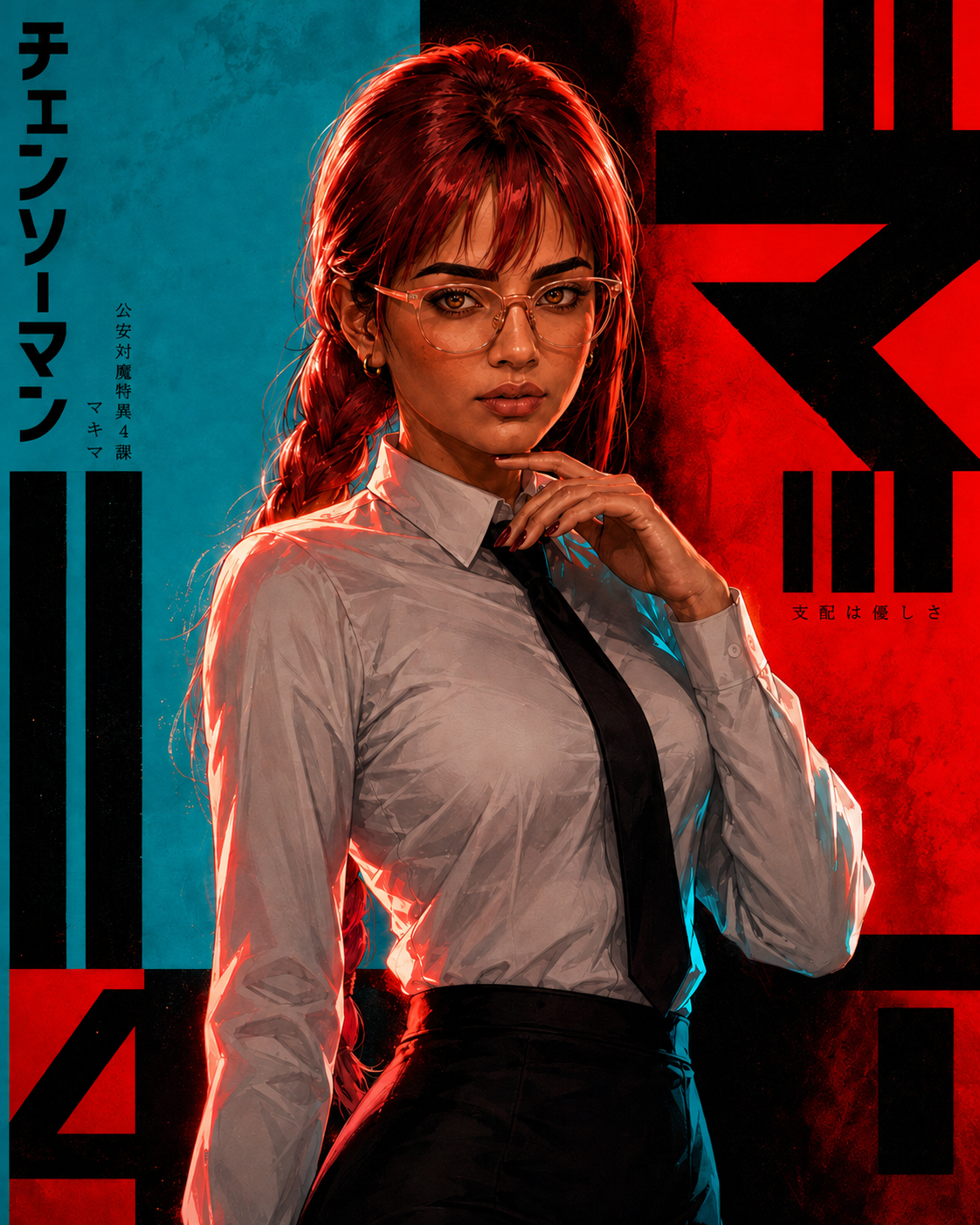
Use the uploaded reference image as the primary source for the person. Transform the girl in the reference into a polished, cinematic anime character visually inspired by Makima from Chainsaw Man, while keeping the girl’s own facial identity clearly recognizable. The final result should feel like a high-end Makima character adaptation of the exact person in the reference, not a generic anime girl and not a replacement with Makima’s face. Preserve the reference person’s exact facial structure, face proportions, eye placement, nose shape, lips, cheek structure, jawline, chin, skin tone, hairline and overall recognizable identity. Her face must remain identifiable as the same person even after the anime transformation. Do not make her look like a different real person or simply paste Makima’s face onto her. The overall character design should strongly capture Makima’s distinctive Chainsaw Man aesthetic: elegant, intimidating, composed, sophisticated and slightly mysterious. Give the character Makima-inspired visual traits such as long reddish-orange/copper hair, smooth straight hair with controlled strands and a refined appearance, with the characteristic long braid when appropriate to the composition. The hair should have rich dark auburn/red-brown roots transitioning into warm copper-red highlights, with glossy cinematic reflections and carefully separated anime strands. If the reference person's hairstyle needs to be adapted, preserve the general silhouette and recognizable characteristics of the original hairstyle where possible while introducing Makima’s signature reddish-orange color and polished styling. The character should have the calm, confident, emotionally restrained presence associated with Makima. The eyes are a major part of the visual identity and should receive extremely detailed treatment. Use Makima-inspired golden amber/yellow eyes with her distinctive concentric spiral/ring pattern in the irises. The irises should glow subtly with layered golden, amber and orange tones, with multiple precise circular rings rather than ordinary anime eyes. Keep the underlying eye shape and spacing based on the reference person's face so that the person remains recognizable. Add sharp but elegant upper eyelashes, controlled eyeliner and subtle shadow around the eyes. The eyes should feel hypnotic and slightly unsettling without becoming exaggerated, cartoonish or monstrous. Render the character in a premium semi-realistic anime/fashion-illustration style rather than a flat cartoon style. Preserve realistic human anatomy and facial proportions while using refined anime rendering, exceptionally clean linework, smooth skin rendering, detailed eyes, painterly gradients and carefully controlled highlights. The face should have delicate anime refinement but retain believable bone structure, natural cheeks, realistic nose and lips, and the actual proportions of the reference person. Avoid the generic oversized eyes, tiny nose, overly pointed chin or exaggerated facial proportions commonly produced by basic anime styles. The clothing and styling should strongly evoke Makima’s iconic Public Safety appearance: a crisp fitted white button-up dress shirt with realistic fabric construction, structured collar, subtle folds and natural tension around the shoulders, arms and torso, paired with a dark black necktie and a sophisticated dark lower outfit such as a black pencil skirt or tailored black trousers depending on the reference composition. The clothing should look premium and physically believable, with realistic fabric thickness, seams, folds, buttons, shadows and highlights. Keep the pose and body proportions from the reference image unless a pose adjustment is explicitly requested. The outfit should feel like an elegant cinematic reinterpretation of Makima’s uniform rather than a cheap cosplay costume. Use dramatic cinematic lighting with strong red-orange rim lighting and cool cyan/blue opposing light. The character should be illuminated from one side by an intense warm red/orange source, producing glowing highlights along the hair, cheek, jaw, shoulders and edges of the clothing, while a contrasting cyan/turquoise light creates cool highlights and separation on the opposite side. Create deep but controlled shadows across the face, hair and clothing. The lighting should feel like a stylized anime movie poster or premium character key art, with strong directional contrast, luminous skin highlights and glossy reflective hair. Keep the face readable and attractive rather than allowing the lighting to obscure important facial features. The background should reproduce the bold graphic poster language of the reference: an intense split-field composition dominated by saturated cyan/turquoise and vivid crimson/red, with large geometric black graphic elements layered over the background. Use thick vertical and horizontal black bars, abstract rectangular forms, oversized typography-like shapes and sharp geometric blocks that partially intersect the composition. The background should feel like a sophisticated Japanese anime promotional poster, combining minimalist graphic design with aggressive high-contrast color blocking. Keep the background visually striking but subordinate to the character, with enough negative space around the face and silhouette to maintain strong separation. Use a highly saturated palette centered around Makima’s signature red/copper hair, golden eyes, white shirt and black clothing, contrasted against electric cyan and intense crimson background colors. Blacks should be deep and graphic, whites should have cool blue reflections and warm highlights, reds should be vivid and cinematic, and cyan should appear almost neon. The colors should be deliberately stylized rather than photorealistic, with clean color separation and controlled gradients. Add subtle cinematic bloom, soft atmospheric glow, very fine film grain, delicate painterly texture and polished digital-art finishing. Hair highlights should be sharp and glossy, skin should have smooth but slightly painterly tonal transitions, and clothing should contain detailed material-specific shading. Use hard-edged shadows and graphic color transitions in selected areas to create the illustrated poster aesthetic. The final image should look like premium anime character key art created by a highly skilled digital illustrator, combining semi-realistic anime rendering, fashion illustration, cinematic lighting and modern Japanese graphic-poster design. The composition should feel powerful, elegant and slightly ominous. Give the character a calm, controlled expression inspired by Makima’s personality: neutral or subtly confident, composed, almost emotionless, with a quiet sense of authority. Avoid exaggerated smiles, childish expressions, excessive cuteness or dramatic emotional expressions. The character should look directly toward the viewer or maintain the same gaze direction as the reference, with a subtle commanding presence. Most importantly, treat the uploaded reference image as the identity and structural source and the Makima image/style as the visual-design target. Transfer the Makima-inspired hair color, golden spiral eyes, elegant Public Safety styling, restrained expression, cinematic red/cyan lighting, semi-realistic anime rendering and bold graphic poster treatment onto the reference person while preserving her recognizable face. Do not alter her facial identity merely to make her resemble Makima. Do not produce a generic Makima character. Produce the exact reference girl reimagined as a Makima-inspired Chainsaw Man character, with maximum facial recognizability and maximum consistency of her original facial proportions.